
Healthy life expectancy: Britain’s hidden health crisis
Healthy life expectancy sounds like one of those dry statistical phrases dreamt up by civil servants in a Whitehall basement. In reality, it may be one of the most important numbers in modern Britain
Because it doesn’t simply ask: ‘How long will you live?’
It asks: ‘How long will you live well?’
That’s a very different question
Recent Office for National Statistics (ONS) data paints a troubling picture. Britons are still living relatively long lives, but we are spending more of those years in poor health. In simple terms, we are increasingly surviving rather than thriving
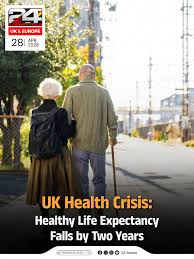
The latest ONS figures suggest healthy life expectancy in the UK has fallen to around 61 years for both men and women – the lowest level since records began in this form
Yet average life expectancy remains roughly 79 years for men and 83 for women
Do the maths and the implication is stark
The average British man may now spend close to 18 years in ill health. The average woman may spend more than 20

That doesn’t necessarily mean lying in hospital beds for two decades, but it may mean arthritis, diabetes, reduced mobility, chronic pain, heart disease, declining fitness, medication dependency, poor mental health or increasing frailty
And this isn’t just about old age either
One of the most alarming findings is that in many parts of the UK, healthy life expectancy is now below the state pension age of 66
Think about that for a moment
In much of Britain, people are expected to become unhealthy before they officially retire
That has enormous consequences – economically, socially and personally
The NHS feels the strain. Social care feels the strain. Families feel the strain. Employers feel the strain. But above all, individuals feel the strain
Because most of us don’t fear death nearly as much as we fear decline
We fear losing independence. Losing mobility. Losing energy. Losing dignity
The regional inequalities are equally shocking. In affluent areas such as Richmond upon Thames, healthy life expectancy can approach 70 years. In poorer areas such as Blackpool, it can be barely above 50
That’s not merely a health gap
It is almost two completely different countries
Of course, poverty, housing, employment and access to healthcare matter enormously. Public health experts are right to emphasise the social determinants of health
But lifestyle matters too. Probably more than many people wish to admit
Britain has become simultaneously overfed and undernourished. We move less, sit more, sleep poorly and consume astonishing amounts of ultra-processed food. Obesity, type 2 diabetes and inactivity have become normalised
The irony is that many of the solutions are not mysterious
Walk more
Lift weights
Eat better
Sleep properly
Drink less alcohol
Stop smoking
Maintain friendships
Stay mentally active
None of this guarantees a long and healthhttps://youtube.com/shorts/DA3umC-uUcU?si=iDYAaSm_lbn9ZL8gy life. Genetics and luck still matter. You can do everything ‘right’ and still become ill. Equally, some people seem to survive on cigarettes, fry-ups and bitterness until 94
But population-wide statistics don’t lie
The probabilities are heavily in favour of healthier habits producing healthier ageing
One encouraging aspect of recent research is the growing evidence that physical decline isn’t inevitable at the ages many people assume. Muscle can still be built in your seventies and eighties. Cardiovascular fitness can still improve. Balance and mobility can still be trained
That matters because healthy life expectancy isn’t simply about avoiding death It is about compressing illness into the shortest possible period at the end of life
In other words, the ideal isn’t merely to live longer
It is to stay active, capable and independent for longer
There is also a psychological dimension to all this. Modern Britain often treats ageing as decline rather than adaptation. Yet many older people remain extraordinarily active – travelling, exercising, learning, volunteering, socialising and contributing well into later life
 The challenge isn’t ageing itself
The challenge is unhealthy ageing
And perhaps this is where healthy life expectancy becomes a more useful measure than raw lifespan. A society obsessed purely with longevity can end up missing the point entirely
A longer life isn’t automatically a better life
Quality matters as much as quantity
Perhaps more
The real ambition should not simply be adding years to life, but adding life to years
Because if recent ONS data tells us anything, it is this: Britain’s problem is no longer primarily how long we live
It’s how well!





Leave a reply
You must be logged in to post a comment.