

Discounted Gift Trusts: clever inheritance tax planning – or an expensive trap?

Inheritance tax planning in Britain increasingly feels like a race against time
House prices have soared, pension rules are tightening, and more middle-class families are discovering that a ‘wealthy estate’ now includes people who simply bought a decent house in the South East thirty years ago
Against that background, Discounted Gift Trusts (DGTs) have become a popular inheritance tax planning tool
Financial advisers often present them as offering the holy trinity of estate planning:
- immediate inheritance tax mitigation,
- retained withdrawals for life,
- and future investment growth outside the estate
And in fairness, DGTs can be highly effective.
But they aren’t magic.
Nor are they risk-free
Understanding both the advantages and disadvantages is essential before signing away large sums of capital.
The attraction of DGTs
The basic appeal is straightforward
A donor places money – often into an investment bond inside a trust – while retaining the right to fixed withdrawals for life
Because the donor still benefits from those future withdrawals, HMRC accepts that not all the money has truly been given away
An actuarial calculation is therefore carried out.
This creates two elements:
| Element | IHT Treatment |
| Settlor’s Fund (the discount) | Immediately outside estate |
| Residual Fund | Outside estate after 7 years |
That distinction is the key
Unlike an ordinary gift – where the whole amount remains exposed for seven years – a DGT can create an immediate reduction in inheritance tax exposure from day one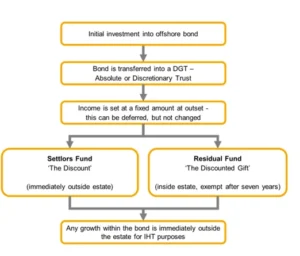
For older retirees in particular, that can be extremely attractive
Immediate IHT mitigation
This is probably the biggest advantage
Suppose £600,000 is placed into a DGT, and the actuarial discount is calculated at £300,000
That £300,000 Settlor’s Fund immediately achieves inheritance tax mitigation.
Only the remaining £300,000 of the Residual Fund must survive for seven years
That means even if the donor dies relatively early, the planning may still produce meaningful inheritance tax savings
Compared with a standard outright gift, the ‘early death risk’ is softened considerably
Retained withdrawals
This is the other major attraction
Many retirees are reluctant to give away capital completely
A DGT offers a compromise.
The donor can continue receiving fixed withdrawals – perhaps 5% per year – while still reducing the eventual inheritance tax bill
Psychologically, that feels safer than simply handing large sums to children outright.
And for many people, it is
Future growth outside the estate
Another powerful feature is that future investment growth within the trust normally remains outside the estate
Over ten or fifteen years, this can become highly significant
Particularly where inheritance tax rates are effectively 40%, removing long-term growth from the estate can yield substantial savings for the next generation
But here come the problems
The issue with DGTs is that the tax advantages are easy to understand
The practical disadvantages are often less obvious
You no longer own the capital
This is the biggest downside of all
Once the money enters the trust:
- you usually can’t reclaim the underlying capital,
- even if your circumstances change dramatically later
You retain only the right to the predefined withdrawals.
That means the arrangement is fundamentally irreversible
If later in life you suddenly need:
- expensive care,
- medical treatment,
- family support,
- or higher income,
the trust capital itself is generally unavailable
That loss of flexibility can become uncomfortable – particularly as people move deeper into retirement
The withdrawals aren’t guaranteed forever
Many people mistakenly think of DGT withdrawals as ‘income’
In reality, they are usually withdrawals from an investment bond
If:
- investment returns are poor,
- markets perform badly,
- or withdrawals exceed growth,
the fund will gradually erode
And if the fund is exhausted, the withdrawals stop
This is not a guaranteed pension
It is still fundamentally an investment product
Inflation risk
A fixed withdrawal may feel generous initially
 Ten or fifteen years later, it may not
During periods of inflation, fixed withdrawals can lose real spending power surprisingly quickly
For retirees facing rising care costs, this can become a serious issue
Complexity and charges
DGTs aren’t simple arrangements
They involve:
- trust law,
- inheritance tax rules,
- actuarial calculations,
- investment bond taxation,
- and ongoing administration
They also frequently involve:
- adviser charges,
- wrapper charges,
- investment management fees,
- and sometimes exit penalties
Those costs can materially reduce long-term returns
The seven-year rule still matters
Although the Settlor’s Fund achieves immediate inheritance tax mitigation, the Residual Fund still depends on surviving seven years
So if death occurs early, part of the inheritance tax exposure may remain
A DGT reduces early-death risk. It doesn’t eliminate it.
The psychological reality
Perhaps the greatest issue is emotional rather than financial
A DGT works precisely because the donor genuinely parts with ownership of capital
Many people are comfortable with that initially
Years later, some aren’t
A common reaction is:
‘I didn’t realise how permanent this really was’
That is why DGTs are often most suitable for people who genuinely have surplus capital rather than simply ‘capital they hope not to need’
Discounted Gift Trusts can be highly effective inheritance tax planning tools
For the right person, they offer a rare combination of:
- immediate inheritance tax mitigation,
- retained withdrawals,
- and long-term estate reduction
But those benefits come at a price: loss of flexibility and permanent surrender of capital
And that is the real balancing act
The question is not simply whether a DGT saves inheritance tax
Often it will
The real question is whether the donor remains financially and psychologically comfortable with the arrangement for the rest of their life
Caveat emptor




Leave a reply
You must be logged in to post a comment.