

Prediction markets for UK investors: insights, signals – and how to act on them
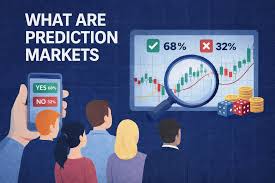
Prediction markets are gaining attention as a powerful tool for forecasting everything from election results to economic trends. At their core, they’re platforms where participants buy and sell contracts based on the likelihood of future events. If the event happens, the contract pays out; if not, it expires, worthless. In theory, the market price reflects the collective probability of that outcome
Platforms such as PredictIt and Kalshi have brought these ideas into the mainstream, while decentralised platforms like Polymarket are pushing the boundaries even further. But are prediction markets genuinely useful – or simply another form of gambling dressed up as data?
For those of us in the UK, however, the landscape looks different. You can often observe these markets but not participate in them easily. Yet that doesn’t mean they’re irrelevant – far from it. Used correctly, prediction markets can provide powerful investment signals, while UK-based platforms offer practical ways to act on those insights
What prediction markets actually do
At their core, prediction markets convert uncertainty into a number.
- A contract trading at 70 implies a 70% probability
- Prices move as new information emerges
- Participants are financially incentivised to be right
This creates something unique:
A real-time, continuously updated ‘consensus probability’ of future events
Unlike polls or expert forecasts, these probabilities reflect what people are willing to back with money, not just opinion
Why investors should care
Prediction markets are not an asset class. They don’t generate income or compound over time. But they can improve decision-making in three key ways
A forward-looking lens
Traditional investing relies heavily on backwards-looking data:
- Earnings
- GDP
- Inflation reports
Prediction markets, by contrast, are explicitly about the future.
For example:
- Rising probability of rate cuts → bullish for bonds and growth stocks
- Increasing recession risk → defensive positioning becomes attractive
- Shifts in election probabilities → sector rotation opportunities
Early warning signals
Because they aggregate diverse information quickly, prediction markets can sometimes outpace traditional markets
A sudden shift from:
- 30% → 60% probability of recession
…may appear in a prediction market before equities fully react
That divergence can be valuable
A check on your biases
Investors are prone to:
- Overconfidence
- Confirmation bias
- Recency bias
Prediction markets provide an external benchmark:
‘What does the market think the probability actually is?’
Even if you disagree, that comparison is powerful
Using platforms like Polymarket (from the UK)
Platforms such as Polymarket are particularly useful because they:
- Cover a wide range of global events
- Update continuously
- Often includes geopolitical and macro questions
For a UK-based reader, the key point is:
You don’t need to trade on these platforms to benefit from them
Instead, you can use them as:
- A probability dashboard
- A sentiment indicator
- A cross-check against mainstream narratives
For example:
- If Polymarket shows a rising probability of geopolitical escalation
- But equity markets remain calm
👉 That gap may signal risk not yet priced in
The UK reality: why you can’t easily trade them
Most US-style prediction markets are not accessible to UK users
Platforms like Kalshi operate under US financial regulation, while decentralised platforms like Polymarket exist in a different legal grey area
Some users attempt to access them via VPNs, but this typically:
- Breaches platform terms
- Risks include account closure or fund loss
- Creates legal and practical uncertainty
👉 In short:
They’re best treated as information sources, not execution platforms
How UK investors can act on these signals
Here’s the crucial insight:
The UK already has highly developed ‘prediction markets’ – they’re just called something else
Betting Exchanges = Practical Prediction Markets
Platforms like:
- Betfair
- Smarkets
- Matchbook
…function in almost exactly the same way:
- Prices reflect probabilities
- Markets move with information
- You can back (buy) or lay (sell)
 In fact, they often have:
- Better liquidity
- Faster pricing
- More tradable markets
…than many prediction platforms
Example 1: Politics
Suppose a prediction market shows:
- 65% probability of a political outcome
But Betfair odds imply:
- Only 50%
👉 That difference may represent value
You can:
- Back the outcome on Betfair
- Or trade the price as it converges
Example 2: Financial markets
Instead of betting directly, you can act via:
- Equities
- Bonds
- Commodities
For instance:
- Rising probability of conflict → consider energy exposure
- Increasing recession risk → reduce cyclical stocks
👉 This is how institutional investors use these signals
Advantages and limitations from a UK perspective
Advantages
- Real-time probability signals
- Aggregation of diverse information
- Useful for macro and event-driven thinking
- Strong complement to traditional analysis
Limitations
- Not directly tradable in the UK (in most cases)
- Some markets are illiquid or noisy
- Ethical concerns around certain topics
- Easy to overinterpret probabilities
Most importantly:
A 70% probability still fails 30% of the time
The key takeaway
Prediction markets are not about replacing investing or betting.
They’re about improving how you think.
For UK users, the optimal approach is:
- Use global prediction markets (like Polymarket) for information
- Translate probabilities into economic or sporting implications
- Execute via UK platforms (Betfair, Smarkets, financial markets)
The real value of prediction markets is not that they tell you what will happen
It’s that they force you to think in probabilities
And once you start thinking that way, you’re no longer guessing
You’re pricing the future
Caveat Emptor!



Leave a reply
You must be logged in to post a comment.