

‘Must see’movie: One Battle After Another
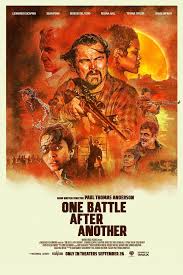
Ever since his feature directorial debut, Hard Eight, in 1996, Paul Thomas Anderson has established himself as one of the finest living American film directors. He has made countless films that have stood the test of time, but he has never made a film quite like One Battle After Another. Ambitious in scope, action-packed, exhilarating, politically charged, heartfelt, and often very funny, it’s his most urgent work to date, owing to its modern political and social content. Given the current state of the world, it may very well go down as the film of our time. Inspired by Thomas Pynchon’s Vineland but very much infused by Anderson’s own personal feelings and fears towards the absurdity of America today, it’s an action-comedy, a political call to action, and a father-daughter drama all wrapped up in one, giving audiences a complete cinematic package that stands as the very best of the year
Leonardo DiCaprio plays Bob Ferguson, an explosives expert working with a faction of revolutionaries who bomb buildings, rob banks and stage rescue raids on deportation camps. Bob is the main squeeze of the group’s fiery leader, Perfidia Beverly Hills (Teyana Taylor), a passionate but reckless advocate for reproductive rights, open borders and Black liberation. Her ferocious ardour is so magnetic that even an avowed enemy like vicious jackboot Col. Steven Lockjaw (Sean Penn) feels drawn to her. What ensues from that attraction sets One Battle After Another on its years-spanning odyssey of deliverance and reprisal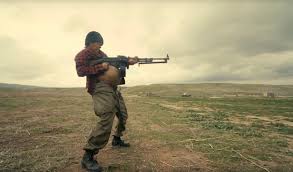
The birth of Bob and Perfidia’s daughter, Willa, transforms the stakes. Sixteen years later, Willa (Chase Infiniti, in a startlingly confident debut) is a restless teenager drawn to karate and her circle of friends, while Bob has spiralled into paranoia, trying to raise her in exile under false identities. Meanwhile, Lockjaw has aligned himself with the Christmas Adventurers – a clandestine white supremacist order featuring Tony Goldwyn, John Hoogenakker, and Kevin Tighe – yet never releases his grip on the past. His vendetta culminates in a siege on Baktan Cross, the countercultural Northern California town sympathetic to ‘60s survivors and revolutionaries. There, Bob, aided by Sensei Sergio St. Carlos (Benicio del Toro, a sea of amusing serenity amid DiCaprio’s chaos), and remnants of the French 75 rally to protect Willa from Lockjaw’s tightening, laser-focused snare
This is only a fragment of Anderson’s boundless and unpredictable narrative. The film ricochets between modes – an opening charged with fire and resistance, sharp comedy that bubbles with absurdity, bursts of danger that unsettle, and moments of striking poignancy. One Battle After Another acknowledges America’s fractured sociopolitical fabric but remains a story of people rather than polemics. The sweep is archetypal – original sin, exile, menace, redemption – yet Anderson resists convention at every turn. And as a bonus, the movie features the tensest and yet surreal car chases ever committed to screen in the third act, as if PTA channelled his inner David Lynch
The cast is uniformly excellent. DiCaprio serves as the film’s anchor, wringing both hilarity and angst from his performance with committed precision. Taylor burns with conviction, Hall brings warmth and sharp edges, and Del Toro embodies balance and wisdom. But it is Penn who emerges as the film’s most startling force. His Lockjaw is grotesque and riveting, a performance that veers between menace and absurdity. A racist ideologue undone by his obsession with Perfidia, he is both monstrous and darkly comic – a creation as unforgettable as it is unhinged
Visually, the film soars. Michael Bauman’s VistaVision cinematography is sweeping yet incisive, alternately grand and piercingly intimate. Jonny Greenwood’s haunting score is as unconventional as ever, brimming with jagged textures, but swells into moments of orchestral power when the story demands it. The film is a storm of controlled chaos, yet Anderson orchestrates every movement with clarity
And while its political dimension may invite distortion or misreading in bad-faith arenas, at its core, One Battle After Another is a father-daughter story – of a man haunted by the past yet striving to live in the present, finally stepping up and hoping to prepare the next generation to learn from history’s mistakes. It’s also about the reckoning between the person you are, the person you awaken to in your complacent stoner haze, and the parent you hope to be – and how the self you imagine doesn’t always align with the father you long to become
From one generation to the next, the struggle endures. Fierce and unrelenting, One Battle After Another burns as both an incendiary action epic and a tender family drama, alive with humour, conviction, and revolutionary spirit. And amid all its pandemonium, Sergio’s reminder that “freedom is no fear” lingers as the film’s quiet truth, a mantra passed down like a torch. Few films this year feel so vital, so breathtaking in scope and soul



Leave a reply
You must be logged in to post a comment.